Measured skin results
A response rate, a wrinkle measurement and a change in firmness answer different questions. The distinction starts with a frequently repeated percentage.
Participants with increased procollagen
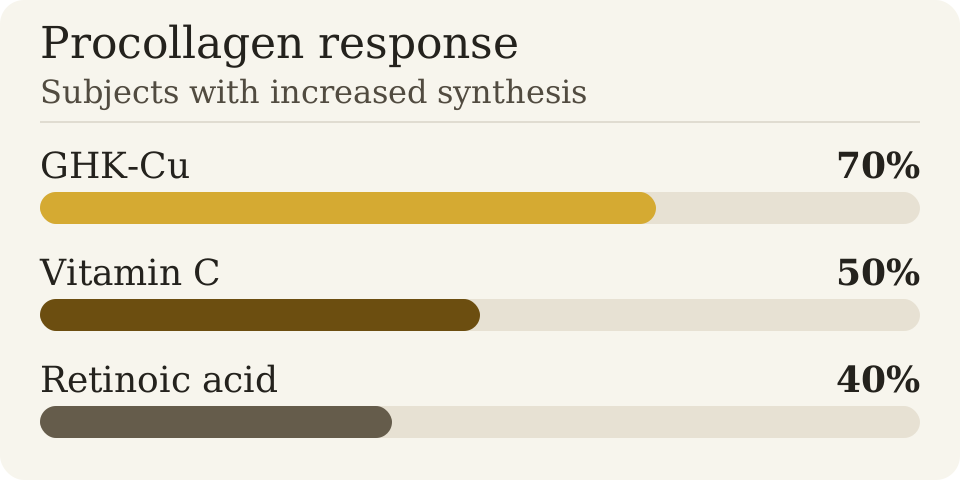
The anti-wrinkle review reports increased procollagen synthesis in 70% of GHK-Cu-treated subjects, 50% for vitamin C and 40% for retinoic acid. Procollagen is the precursor from which collagen is made. The percentages describe the proportion of subjects with that response.
The easy misinterpretation is exactly what irritates me here. The GHK-Cu group had a reported response in 70% of subjects; “70% more collagen” would describe the size of an increase. Those are different quantities. The figure below preserves the count-of-responders meaning.
The same comparison appears in the skin-regeneration review. When that comparison reappears, I go looking for the original work; repetition by reviewers adds context, while the result still comes from the work they are discussing. I cannot treat that repeated percentage as fresh replication.
Skin laxity and wrinkles
The skin-regeneration review describes placebo-controlled improvements in skin laxity, clarity, fine lines, wrinkle depth and density. Those reported outcomes are closer to the face that interests a reader of an aesthetics site than a cellular synthesis measurement is. They also span different aspects of skin. A density finding and a wrinkle-depth finding deserve their separate names.
Here the repair idea finally acquires, for me, an aesthetic purpose. I want a description of the change that could be seen or measured, together with the actual preparation and comparison. The review gives a reason to investigate these outcomes. It does not make them interchangeable.
A single enthusiastic adjective can hide those distinctions. “Firmer” could be the outcome somebody cares about, but it leaves the exact measurement unstated. “Rejuvenation” earns little credit with me until it comes with a skin measurement. That is an editorial judgment about how much a claim explains.
A future facial-skin trial
The review of topical GHK treats poor passage through the outer skin layer as a central problem. This makes the preparation itself interesting: a biological effect and a workable topical formulation have to meet in the same experiment.
An experiment worth waiting for would put a clearly specified formulation, a suitable control and a plainly reported facial measurement together. I would also want the size of the change and the spread of responses, rather than only a proportion who crossed a response threshold. That is a wish for a more useful experiment, with no prediction about its result.
The count in the chart is worth understanding on its own terms. The larger aesthetic question remains how a particular preparation changes a particular skin outcome. Through skin follows the material problem that stands between the culture dish and that experiment.