Through skin
An active ingredient still has somewhere to go. Here the research becomes a problem of barriers, material forms and what actually crossed.
The outer skin layer
The review of topically applied GHK identifies poor stratum-corneum permeability as the central delivery challenge. The stratum corneum is the outer barrier layer of skin. A response in a culture dish can put a peptide in direct contact with cells; topical application introduces this intervening layer.
I used to treat formulation as the small print after the interesting biology. This review gives me the opposite emphasis. Palmitoylation, which attaches a fatty component to GHK, and microneedle pretreatment appear among the strategies it evaluates. These are research approaches discussed by the review, each changing the conditions under which passage is studied.
Delivery experiments now draw my curiosity in their own right. A modified form or a pretreated barrier creates a more specific question than whether a peptide “gets into skin.” The material, the barrier and the measurement all need names before the result becomes useful. The review evaluates these techniques as experimental delivery strategies.
Copper passage and retention
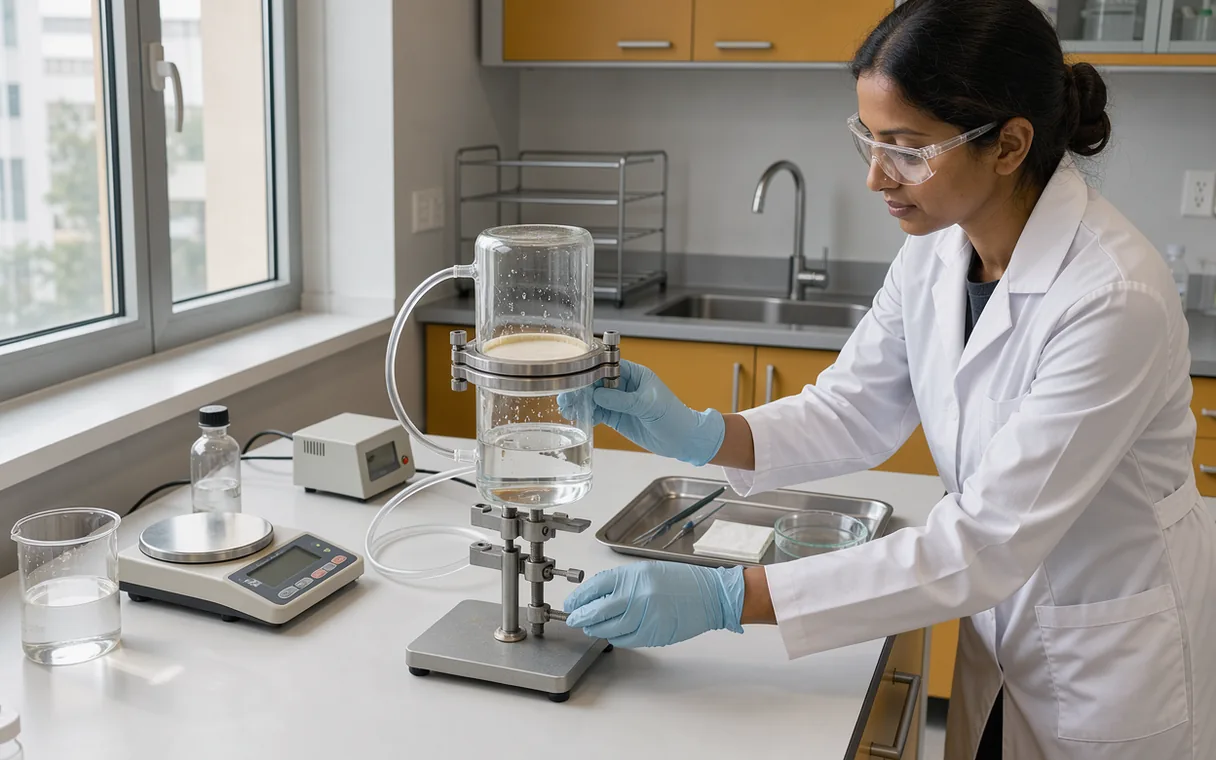
The human-skin penetration study examined copper applied as a GHK-Cu tripeptide preparation in vitro. It measured copper passage through skin samples and retention in the dermis, described as a depot. “Ex vivo” means tissue examined outside the body; this was human skin material, rather than a trial of changes in living participants' faces.
The analyte matters. The recorded result concerns copper. Before accepting an account of intact GHK-Cu arriving at a target, I need a measurement of the intact complex. That is a limit on the claim I can make from the recorded copper measurement, rather than a conclusion about everything the skin contained.
This distinction rescues a useful experiment from an oversized interpretation. The study supports a concrete discussion of copper delivery and retention in a skin sample. It leaves a separate task for any claim about the amount of intact peptide available where a biological effect is expected.
Formulation and the next experiment
The anti-wrinkle review evaluates ways to improve delivery, including a modified GHK form and barrier pretreatment. Can that delivery gain carry through to a meaningful skin outcome? Passage alone leaves that question open. Better passage is a useful intermediate result; the next question is what that passage achieves in the setting being tested.
I resist the shortcut of using a peptide's name as the whole description of a preparation. The review discusses different approaches precisely because the physical conditions matter. A result under one set of delivery conditions gives a reason to test that set carefully. Extending it to another preparation would require another argument.
The restoration desk has room for this apparently unglamorous work. It is difficult to talk sensibly about repair while leaving the destination vague. The collagen experiment supplies the biological interest; the skin-results page supplies the outcome questions waiting at the far end of a delivery study.